
The Club Demo: Where Craft Comes Alive
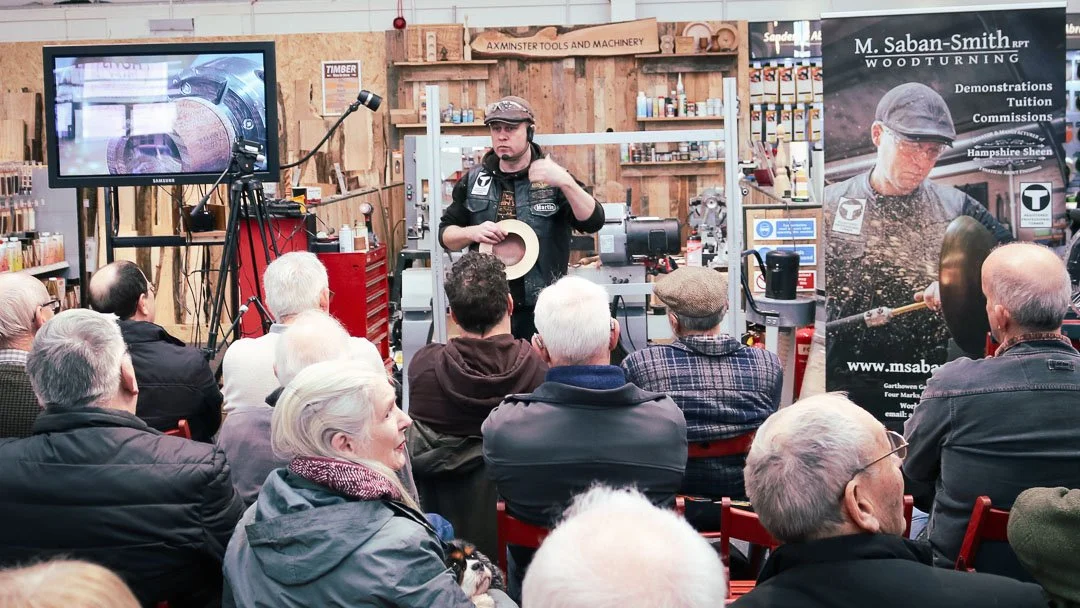
There's a moment in every good demonstration when the starts for the first time and the tool lands on the rest, and the audience go quiet in anticipation. The tool has found its line. The shavings are curling off in that satisfying ribbon. The form is emerging from the blank, and everyone can see where it's going.
That moment is why I've been demonstrating at clubs, shows, and events since 2015. It's why I still pack the car and drive to village halls and community centres. And it's why I think live demonstrations — whether in person or via a good remote setup — remain one of the most valuable things a woodturning club can offer its members.
What a Demo Actually Does
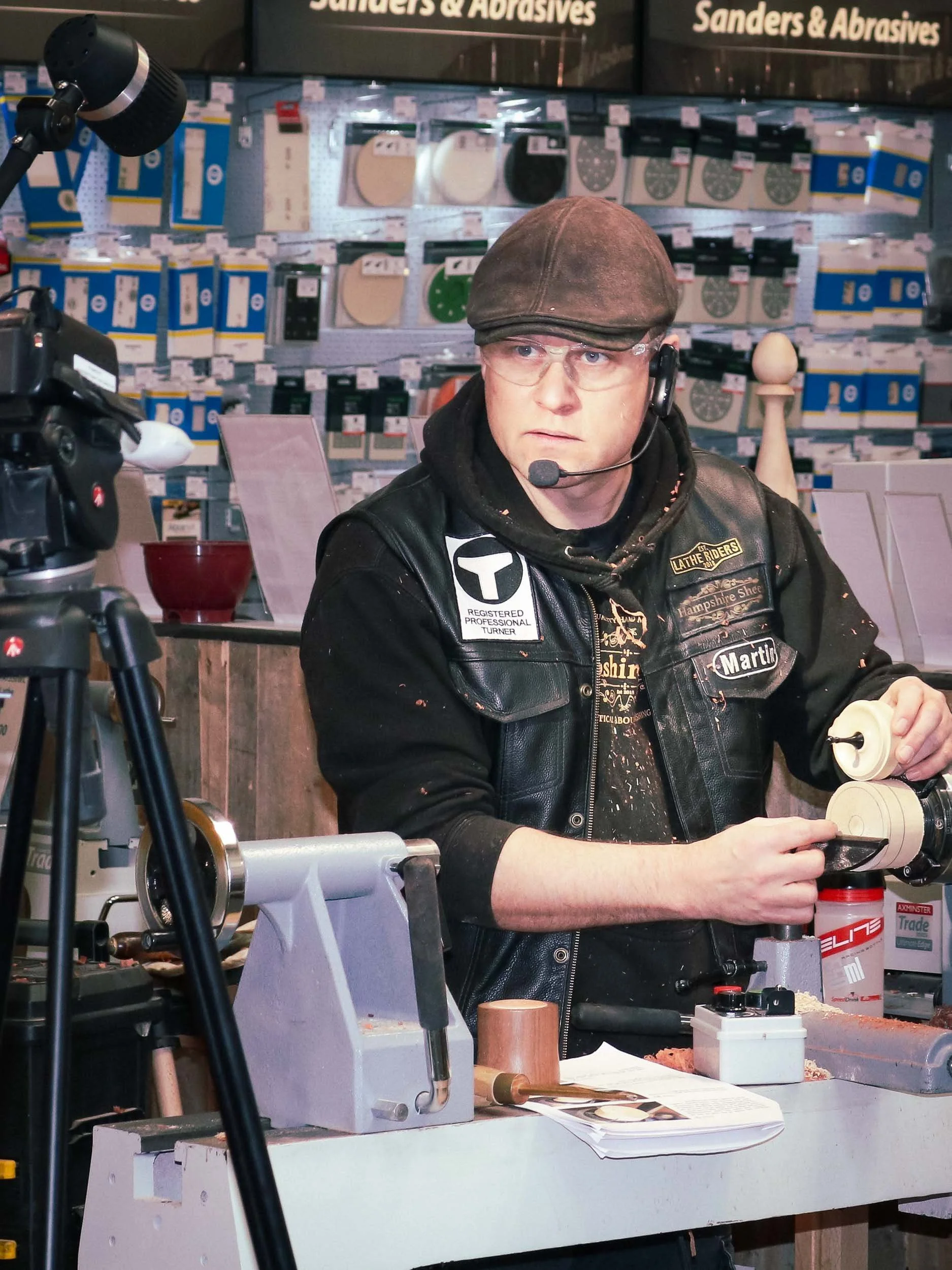
YouTube is brilliant. I've got nearly 300 videos on my channel, and I know they help people. But there's something a pre-recorded video can't do: respond to the specific question forming in your mind at that exact moment.
"Why did you angle the tool that way?" someone asks from the third row.
I stop. I show them the angle. I explain why — not the textbook answer, but the real answer based on this particular piece of wood, this grain direction, this problem I'm quietly solving. Then someone else asks a follow-up question, and we're in a conversation that helps everyone in the room, including me.
A good demonstration isn't a performance. It's a conversation that happens to involve a lathe.
I've learned as much from teaching as from any piece of wood. Student questions force me to articulate things I know instinctively but have never put into words. Their struggles reveal assumptions I didn't realise I was making. Every club, every audience, teaches me something new about how to communicate what I do.
The Community Connection
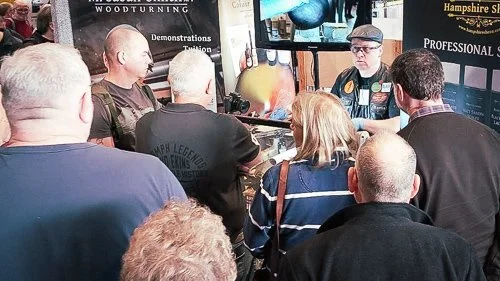
Woodturning can be a solitary craft. There's beauty and peace in that solitude — just you and the lathe and the meditative rhythm of shavings falling. But craft also grows through connection, through seeing how others approach the same challenges.
Club nights are where that connection happens. A visiting demonstrator brings fresh perspective. They do things differently — not better or worse, just differently — and that difference sparks ideas. "I never thought to approach it that way," is something I hear often. And I hear it because I'm doing something I consider ordinary, something that's become invisible to me through habit.
That's the magic of demonstration: making the invisible visible again.
Over the past decade, I've demonstrated to clubs across the UK and further afield — from Sandon Woodturners in Essex to the SWAT Symposium in Texas, from Grampian Woodturners in Scotland to the Irish Woodturners Guild Seminar in Limerick. Each club has its own character, its own mix of beginners and old hands, its own questions and curiosities. Each demo is different because the audience is different.
What I Focus On
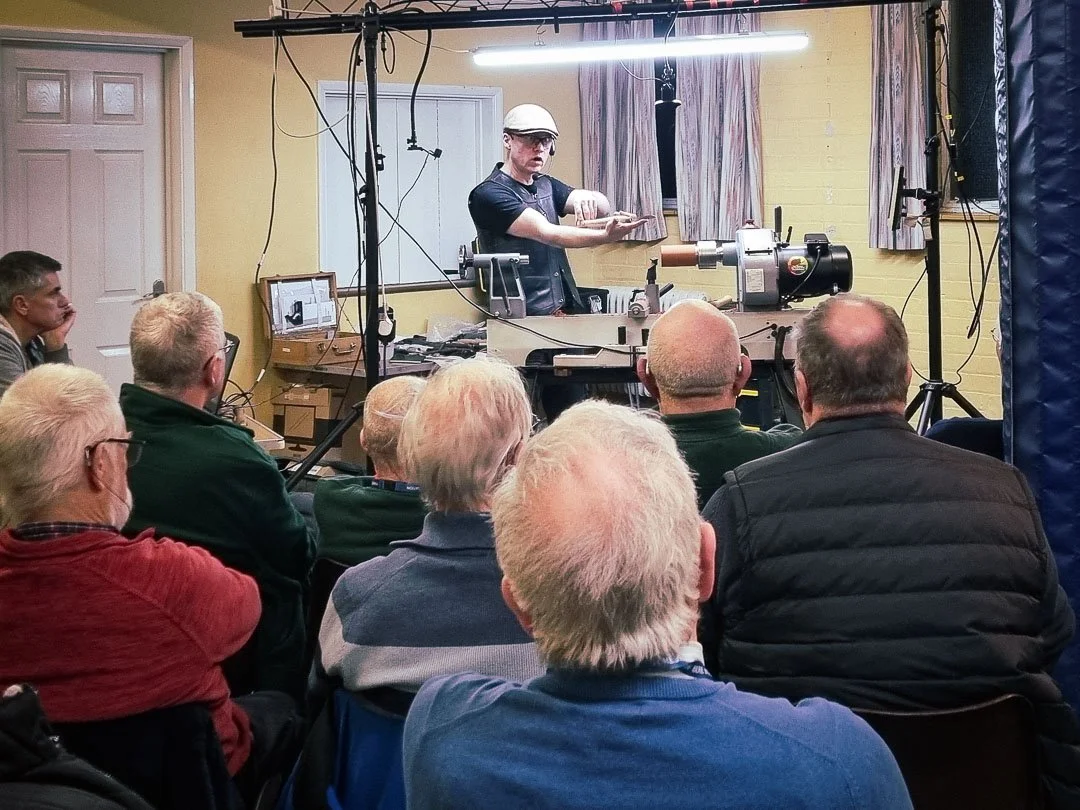
My demos tend toward form, design, and finishing — the areas I'm most passionate about. Not because technique doesn't matter (it does, enormously), but because I think design thinking is often undertaught in woodturning. We spend hours learning to cut cleanly, but less time asking why this shape rather than that one, why this proportion feels balanced while that one doesn't.
I explain the thinking behind the techniques, not just what I'm doing, but why. My book, Woodturning: Form and Formula, explores how the Rule of Thirds and Golden Ratio can guide your eye and hand at the lathe. These aren't rigid rules — they're gentle guides toward pieces that feel right. Understanding why a proportion works helps you break the rules deliberately, when you should, rather than accidentally.
And finishing? Finishing is where respect for craft shows. The last 10% of a piece takes 50% of the care. I built Hampshire Sheen because I couldn't find finishes that gave me the tactile quality I wanted. Though the brand has now closed, some of the range is still available, and finishing remains central to what I demonstrate and teach.
In Person or Remote — Both Work
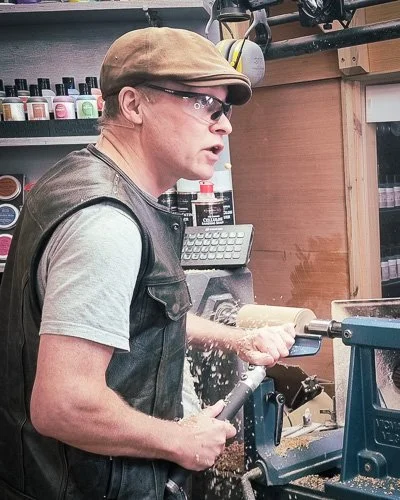
There's nothing quite like being in the room. The smell of fresh shavings, the sound of the cut, passing a finished piece around for people to feel the surface. When I travel to a club, I bring shavings and enthusiasm; they provide the lathe and the audience.
But I was at the forefront of the UK rush to provide remote demonstrations when Covid hit in 2020, and honestly? Good remote demos can be excellent. Sometimes better than being there.
My purpose-built studio has seven cameras, custom on-screen graphics, and Starlink broadband for rock-solid 1080p streaming. Every viewer gets a front-row seat — closer than the front row, actually. You can see the tool angle, the grain direction, the exact moment the bevel is rubbing. Details that would be invisible from the back of a village hall become crystal clear.
For clubs where my travel costs would be prohibitive, remote is the practical choice. All you need is a screen and an internet connection.
What Happens After
The real measure of a demonstration isn't applause at the end. It's what happens when your members get back to their own lathes.
Do they try something new? Do they approach a familiar technique differently? Do they start noticing proportions, asking themselves why this curve rather than that one?
I provide demo notes for distribution to club members after each session. These aren't comprehensive tutorials — they're reminders, prompts, starting points for further exploration. The demo itself plants seeds; the notes help those seeds grow.
What gives me the most satisfaction is seeing other people grow in their craft. Whether it's a club member refining their sense of proportion after a demo on design, or someone writing to say they finally understood a technique they'd struggled with for years. Those moments are the real reward.
Booking a Demo
My calendar for 2025 is filling up nicely, and I'm already taking bookings for 2027!. If your club would like to host a demonstration — in person or remote — I'd be delighted to hear from you.
I'm currently demonstrating to clubs from West Riding Woodturners to Central Arkansas Woodturners, from Dorset Woodturners (all-day masterclass) to the Wilmington Area Woodturners in the USA. The beauty of remote demos is that geography stops being a barrier.
You can also catch me at trade shows and events — I'll be at Yandles again, and various Axminster locations throughout the year. The full schedule is on my website.
The Craft Grows Richer When It's Shared
Community has always been important to me. I founded Woodturning360, an online club where we meet twice a month — once for a demonstration from professional turners worldwide, once for informal discussion. The club now brings together members from eleven countries, all with the same enthusiasm for turning and learning.
All aspects of what I do reflect a simple belief: craft grows richer when it's shared with others.
A demonstration is sharing in its most direct form. Showing what you know. Explaining why it matters. Watching someone's face when they realise they could do this too.
That quiet moment when the room goes still? That's craft coming alive. And it's why I'll keep packing the car, setting up the cameras, and making shavings in front of anyone who wants to watch.
Book a demonstration for your club: www.msabansmith.com/demos
Watch free tutorials on YouTube: @msabansmith
Get the book — Woodturning: Form and Formula: www.msabansmith.com/shop
Join Woodturning360 (online club): www.woodturning360.com
In-person classes at The Woodturning School: www.thewoodturning.school