
 Image 1 of 1
This project has been extracted from my book, Woodturning: Form and Formula, which explores the Golden Ratio and Rule of Thirds in much greater depth with sketching techniques, professional examples, and seven projects (including this one) designed to help you develop your eye for proportion. After purchase, you will be presented with a download link for the file.
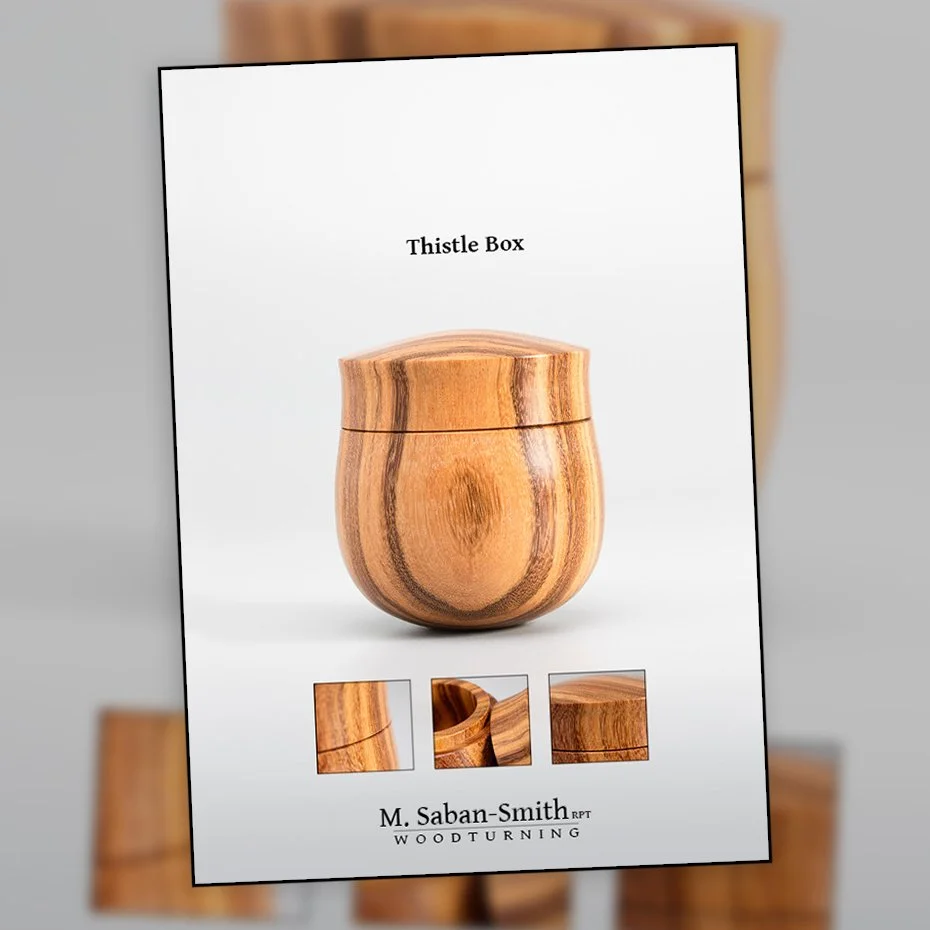
The Thistle Box borrows its character from the flower, with the flared lid echoing the bloom, the body tapering down like the stem. It’s a box with attitude, but the attitude has to be earned. Get the proportions wrong, and it looks like it’s trying too hard. Get them right, and it feels inevitable, as though it couldn’t have been any other shape.
This is a step up from simpler boxes. The curves aren’t constant arcs. They follow sections of the Fibonacci Spiral. The lid flares outward along one section of the spiral; the body curves inward along another.
Where they meet at the join, those two curves have to feel like they belong together.
That’s the real challenge here: balance. The lid must flare without looking heavy. The body must feel grounded without becoming squat. Push either element too far, and the whole silhouette falls apart.
Technically, this calls for careful hollowing, precise lid fitting, and good tool control through the transitions from bead to cove. Neither curve forgives hesitation or heavy-handedness.
Light cuts, sharp tools, and patience. You can add decoration such as an inlay in the lid, accent lines on either side of the join, but the success of this box depends on getting the proportions right first. Decoration can’t rescue a shape that doesn’t work.
Take your time.
Check your curves often and enjoy the fact that you’re making something with genuine presence — a box that earns a second look depends on getting the proportions right.