
 Image 1 of 1
This project has been extracted from my book, Woodturning: Form and Formula, which explores the Golden Ratio and Rule of Thirds in much greater depth with sketching techniques, professional examples, and seven projects (including this one) designed to help you develop your eye for proportion. After purchase, you will be presented with a download link for the file.
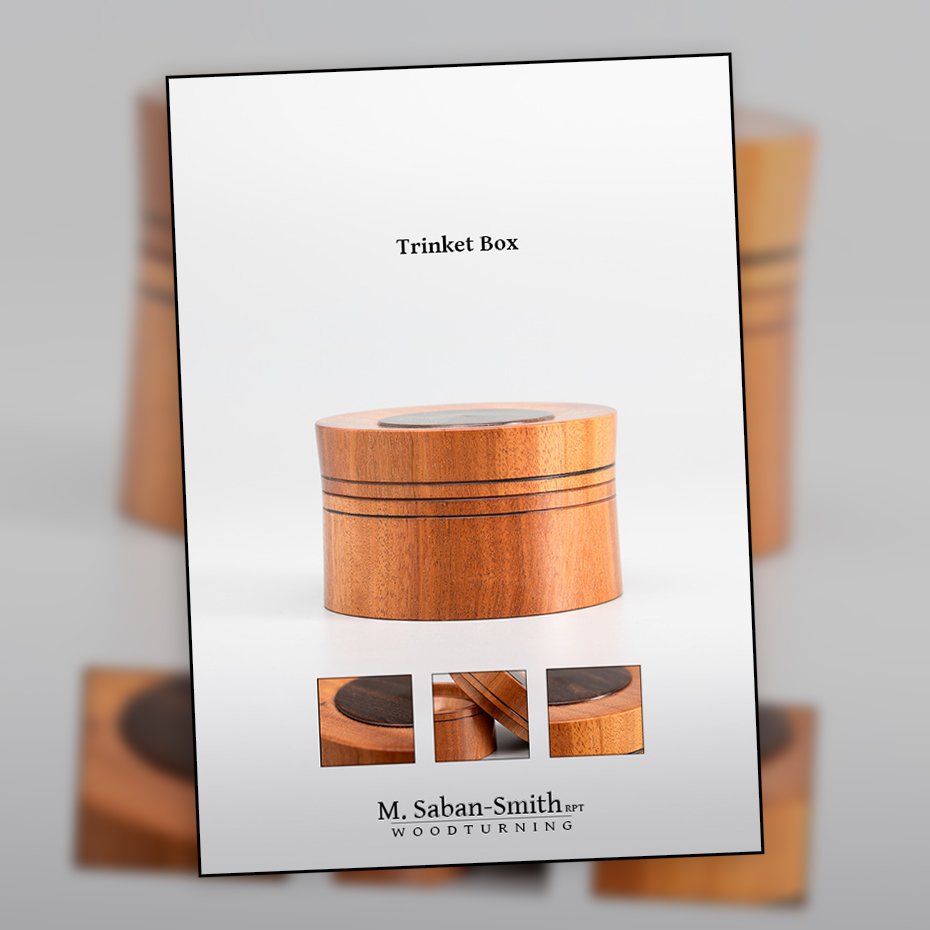
Boxes are brilliant fun to turn. They’re intimate objects, meant to be handled, opened, kept close or perhaps on a dresser, or purely decorative. Either way, this box from my book Woodturning Form and Formula invites touch in a way that larger turnings rarely do. That intimacy is also what makes them unforgiving. Every cut, every joint, every proportion is right there in your hands.
The lid-to-base relationship either feels right or it doesn’t. The join either closes with a satisfying snick or it wobbles and gaps. There’s nowhere to hide sloppy work on something this small.
The dimensions you’ll follow here are based on the Golden Ratio; a proportion found throughout nature and used by makers for centuries. The height of the lid, the curve of the body, the placement of the inlay: all are calculated from this single ratio. You don’t need to understand the maths. Just follow the measurements and notice how the proportions behave. A lid that’s a fraction too tall makes the whole box feel top-heavy. Too short, and it looks timid. The sweet spot exists and the ratio helps you find it.
With an inlay included, this project also lets you play with contrast: mixing wood species to add a quiet focal point without complicating the form. Technically, this is a test of patience more than speed. Hollowing, fitting, sanding, finishing. Rush it and you’ll see the results. Take your time and the box will reward you with something that feels genuinely satisfying to open and close, over and over.
Treat this as both practice and play. Each time you turn one, you’ll understand proportion a little more deeply — and you’ll end up with something functional that’s also quietly beautiful.