
 Image 1 of 1
This project has been extracted from my book, Woodturning: Form and Formula, which explores the Golden Ratio and Rule of Thirds in much greater depth with sketching techniques, professional examples, and seven projects (including this one) designed to help you develop your eye for proportion. After purchase, you will be presented with a download link for the file.
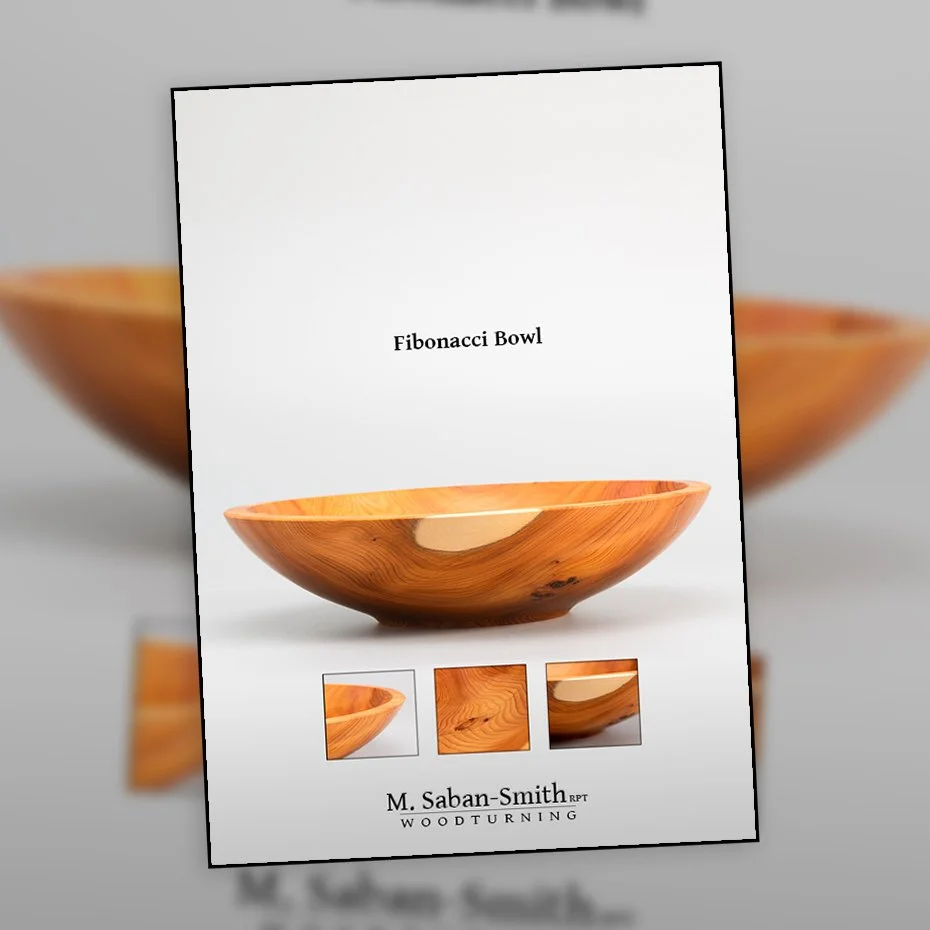
This is the bowl that started it all for me.
Back in 2015, I turned something for a YouTube video using the Golden Ratio for the proportions. They felt inevitable as though the bowl had always existed and I’d simply uncovered it.
That question sent me down a decade-long path exploring the Golden Ratio, and eventually led to writing my Woodturning Form and Formula book.
The idea is beautifully simple. Start with the diameter as your primary dimension. Divide by the golden ratio a couple of times to get the foot. Divide again for the height, a couple more for the rim thickness.
Every measurement flows from that single starting point, each one naturally related to the others.
You’re not juggling separate numbers; you’re unfolding a sequence. The numbers set the framework; the curve brings it alive.
The profile follows the Fibonacci Spiral, the same logarithmic curve found in shells, galaxies, and DNA.
Applied to a bowl, it guides the eye from rim to foot in one continuous sweep, creating a sense of movement and flow that a simple arc can’t match. The eye doesn’t stop at the rim; it’s drawn inward, down into the heart of the piece.
Technically, this is faceplate turning at its most satisfying: sharp tools, light cuts, and frequent checks. Stop the lathe, step back, and look. The profile should feel like it’s pulling you in, not pushing you away.
Whether you turn this as a functional bowl or purely for display, you’ll end up with something that demonstrates how simple calculations can produce timeless results. And once you’ve turned one, you’ll start seeing the ratio everywhere. In other turnings, in nature, in buildings.
It changes how you look at form.